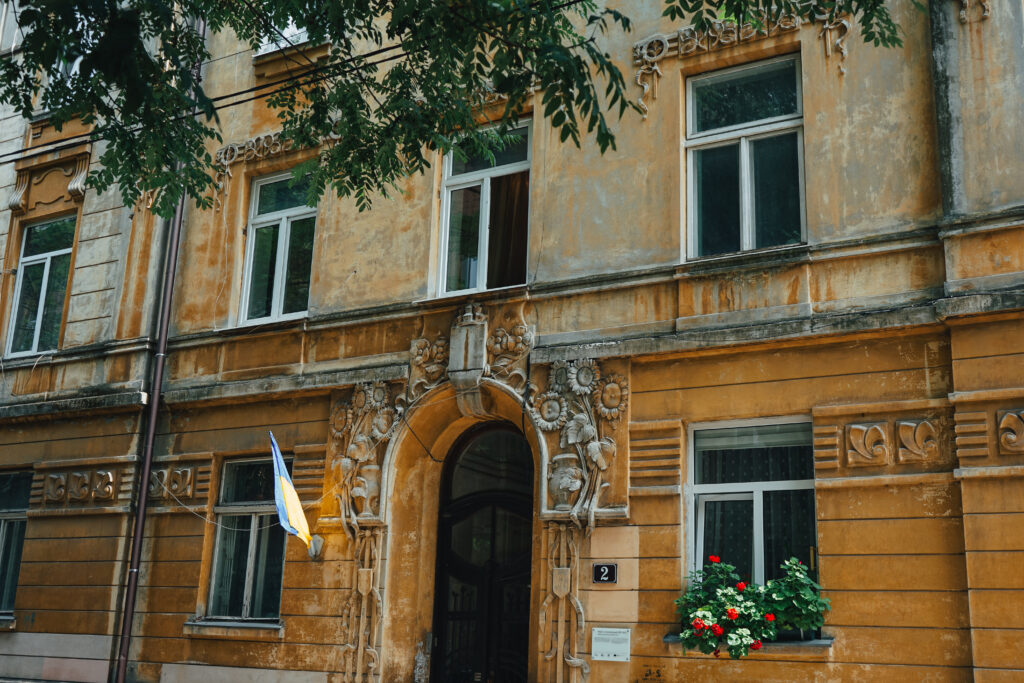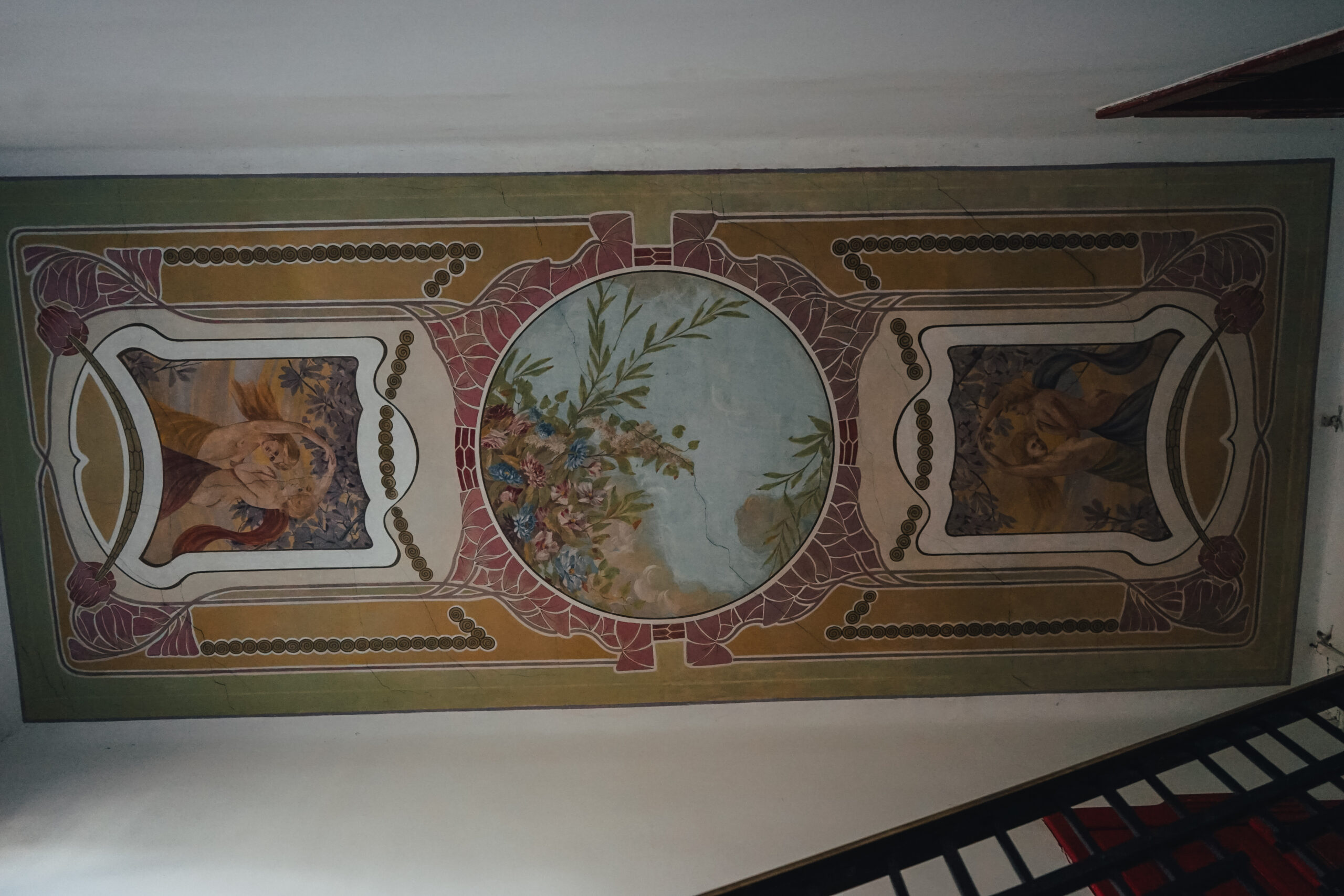
The building at 2 Hlibova Street is one of the finest examples of early twentieth-century Lviv Art Nouveau. Rather than relying on lavish ornamentation, its beauty lies in the harmony of its proportions, flowing forms, and carefully balanced façade.
The townhouse was built in 1906 for Henryk Brich and designed by Tadeusz Obmiński, one of Lviv’s leading Art Nouveau architects. Obmiński played a significant role in shaping the city’s architectural identity by combining the latest European Modernist ideas with local building traditions.
Standing on the corner of Hlibova and Drahomanova Streets, the building takes full advantage of its prominent location. Its chamfered corner crowned with a high gable, asymmetrical projections, and restrained floral ornamentation create a sense of movement—a hallmark of the Art Nouveau style.
One of the building’s greatest qualities is that it changes depending on where you stand. Rather than presenting a single dominant façade, it gradually unfolds as you walk around it, offering a new perspective from every angle.
The building’s most distinguished resident was Marian Smoluchowski, one of the leading physicists of the early twentieth century, a professor at the University of Lviv, and one of the founders of modern statistical physics. Much of his groundbreaking scientific work was carried out in Lviv, earning him international recognition. Although he never received the Nobel Prize, he was considered among its potential candidates, and his discoveries became fundamental to modern physics.
More than 120 years after its construction, the building is still instantly recognizable thanks to its distinctive corner silhouette. It perfectly demonstrates how Lviv Art Nouveau could achieve elegance through refined proportions and thoughtful composition rather than excessive decoration. That timeless design is precisely why the building still feels remarkably modern today.