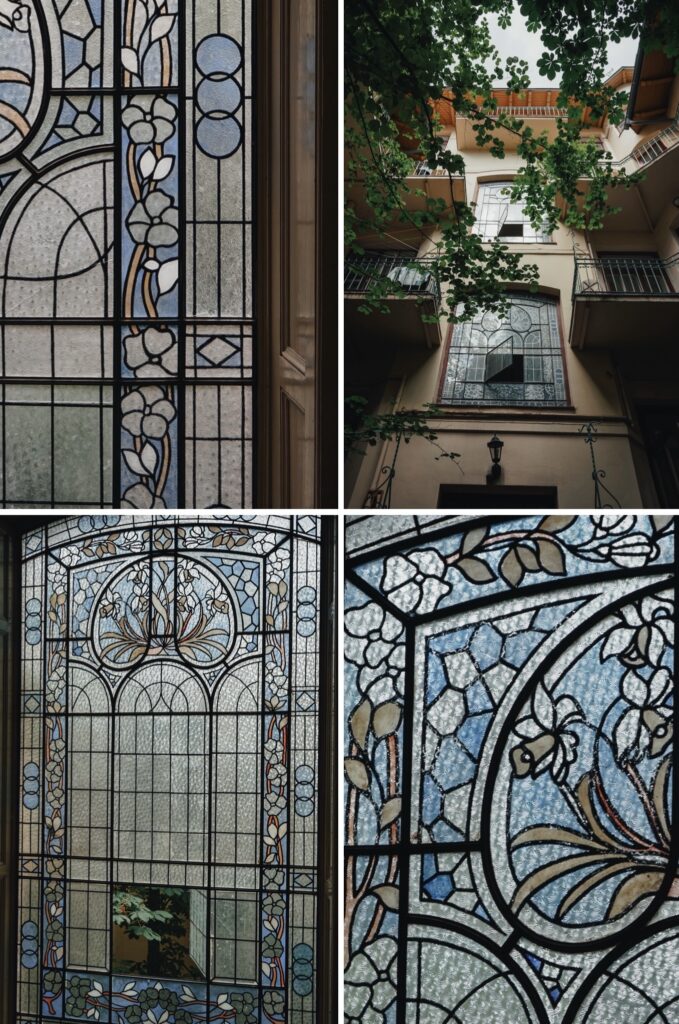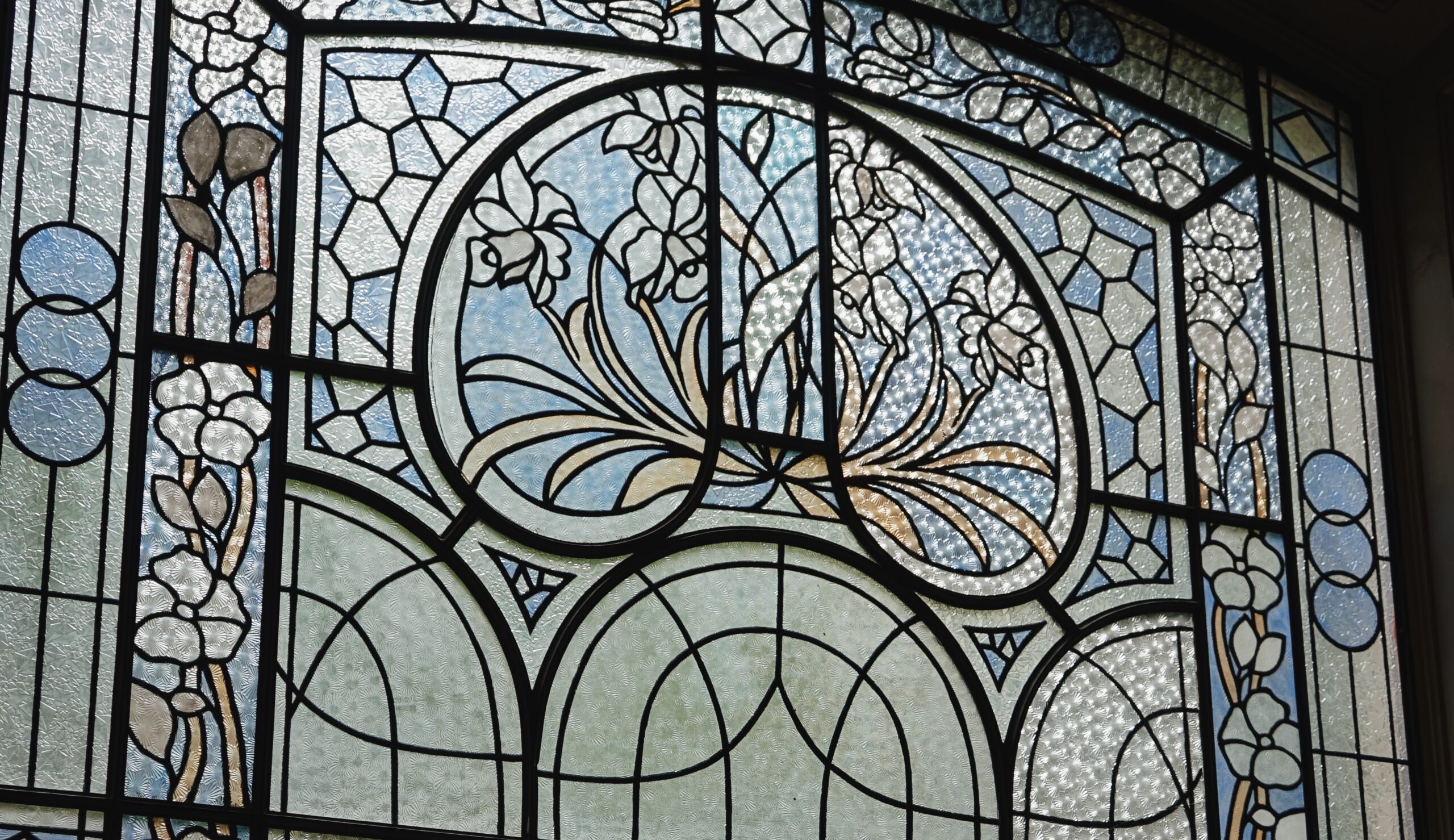
Besides its remarkable façade, the building at 6 Bohomoltsia Street is renowned for its unique Art Nouveau stained-glass window, created in 1905–1906 at the same time as the townhouse itself. Located on the main staircase, it is considered one of the finest surviving examples of residential stained glass from the Art Nouveau period in Lviv.
The composition combines geometric and floral motifs. The upper section features a decorative arch adorned with white and yellow daffodils, while below are stylised stems, leaves, and ornamental patterns crafted from richly coloured green, blue, and amber glass. Thanks to the textured glass, sunlight creates a constantly changing play of colours throughout the staircase as the day progresses.
Art historian Yurii Biriulov suggests that the stained-glass window was produced in the workshop of the renowned Lviv stained-glass artist Leon Appel. His workshop created stained-glass windows for several Art Nouveau buildings along Bohomoltsia Street in 1906–1907, and Appel himself lived nearby on what was then Asnyka Street (today 8 Bohomoltsia Street). Although no documentary evidence confirming his authorship has survived, this attribution is considered the most plausible.
An interesting fact is that the stained-glass window has not survived in its entirety—it remains only partially preserved. Nevertheless, its artistic value is exceptionally high, as the majority of Lviv’s Art Nouveau stained-glass windows from the early twentieth century were lost during the last century. For this reason, the stained-glass window at 6 Bohomoltsia Street remains an important example of Lviv’s decorative art of the Art Nouveau era.