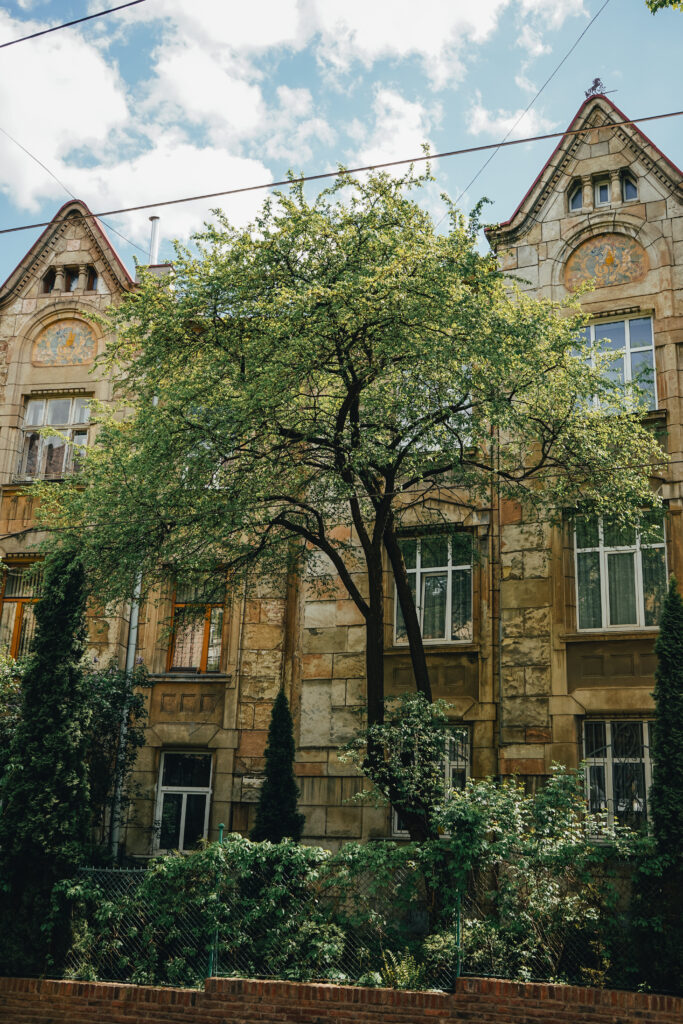
Buildings No. 17 and No. 19 on Kotliarevskoho Street in Lviv are among the most distinctive examples of Art Nouveau residential architecture from the early 20th century. They are often referred to as “twin houses,” as both tenement buildings were constructed in 1910–1911 based on the design of architect Józef Hornung and feature almost mirrored facades.
The buildings are located in the Kastelivka district — one of Lviv’s most fascinating neighborhoods, where a new model of urban housing emerged in the late 19th and early 20th centuries. Here, architects moved away from the dense development of the historic city center and created a “garden city” concept with greenery, small gardens, and villa-style architecture.
Both buildings were designed in the Art Nouveau style. One of their most striking features is the unusual triangular balcony-canopies above the entrance portals — a rather rare architectural element in Lviv at the time. Another remarkable detail is the decorative majolica panels depicting peacocks placed on the upper sections of the facades. In Art Nouveau art, the peacock symbolized beauty, elegance, and ornamentality, making these panels one of the buildings’ most recognizable features.
Despite their similarity, the buildings have mirrored layouts and originally belonged to different owners. Building No. 17 was constructed for Antoni Jakubski, while No. 19 belonged to Leonard and Julia Kwak.
Today, these houses remain an important part of the architectural identity of Kotliarevskoho Street and are considered among the finest examples of Lviv’s residential Art Nouveau architecture from the early 20th century.