On Hlyboka Street, in the “Novyi Svit” district, there is a remarkable example of Lviv’s early 20th-century residential architecture. The townhouse at number 6 was built between 1907 and 1910 as part of an Art Nouveau ensemble of houses at numbers 4, 6, 8, 10, and 12. The project was designed by architects Jakob Rysiak, Władysław Hertmann, and August Bogochwalski.

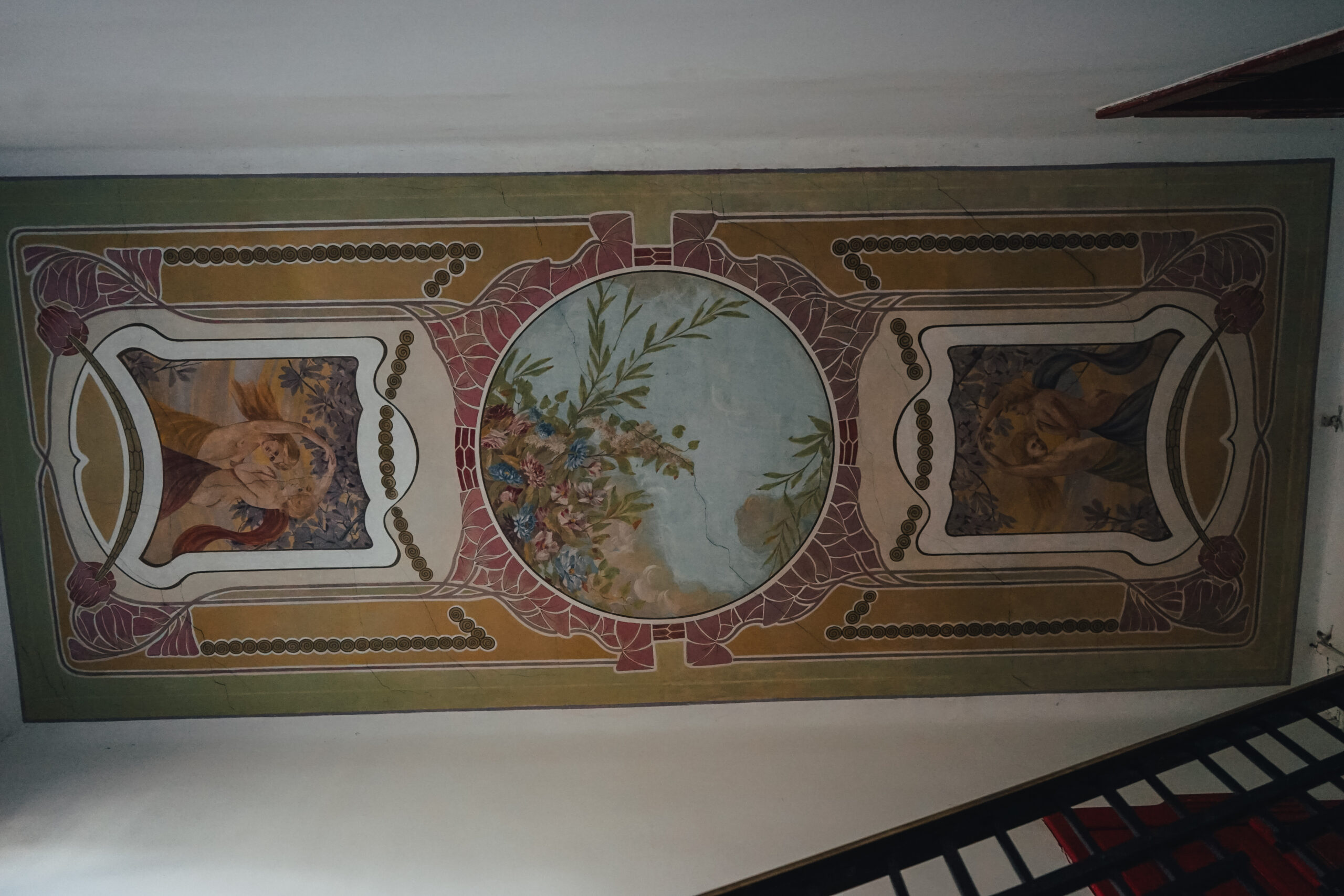
The façade features characteristic Secession details — mascarons and ornamental decoration, documented in archival photographs preserved at the Center for Urban History. Yet the true highlight of the building lies in its interior: in the stairwell a painted ceiling has survived, depicting a putto with flowers and ribbons floating against a sky-blue background, surrounded by garlands of asters, lilacs, and other blossoms. This is a typical example of Lviv’s Art Nouveau stairwell paintings, where artists combined mythological and floral motifs with decorative Secession-style frames.
6 Hlyboka Street is yet another proof that behind ordinary staircases of Lviv lie hidden artistic treasures of the Art Nouveau era.