On a rainy day in Lviv, one can open the door of an old building and suddenly find themselves in another world. At 4 Opilskoho Street hides a true artistic treasure — a Secession-style mural preserved in the stairwell of an early 20th-century tenement house.
The building was constructed in 1910–1911 at the request of Eligia Seidel. The design was created by architect Karol Turkowski, a well-known Lviv architect who worked in the style of mature, or rational Secession. The house on Opilskoho became part of a whole series of properties linked to this family, since the Seidels also owned the neighboring building at no. 2 and the corner house at 20 Antonovycha Street. Their architecture is closely related — the layouts and structures are almost identical, and all the apartments were intended for rent. There were three-room apartments with bathrooms, two-room flats, and also smaller premises for the caretaker and domestic staff.

The façade of no. 4 is restrained yet elegant: nine windows, side risalits, symmetry, and strict proportions. Balconies with wrought-iron railings, pilasters with garlands on the capitals, and geometric chamfers combine classical motifs with the modern logic of the early 20th century. It is an example of mature Secession, which had already moved away from lavish ornamentation but retained attention to detail.
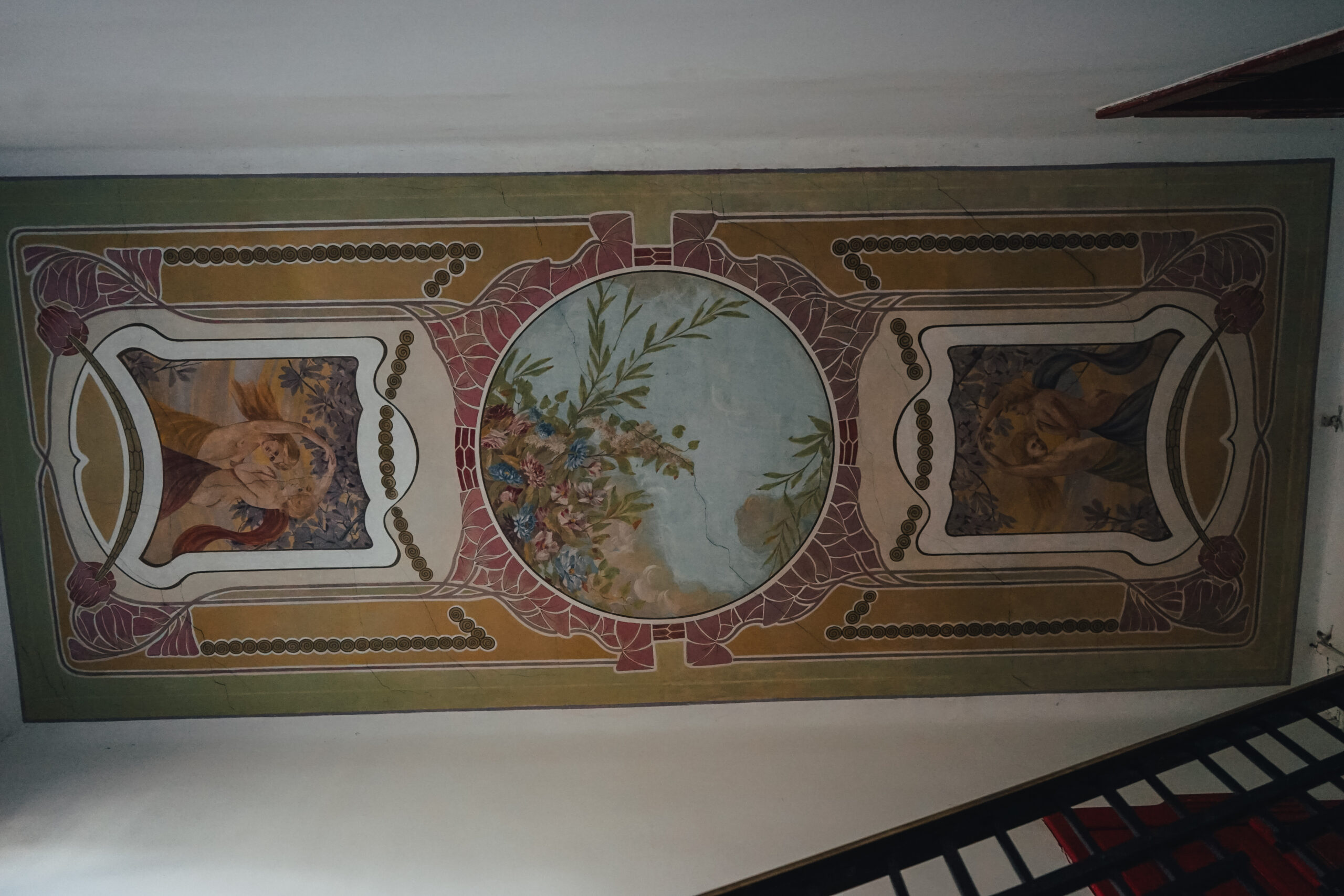
The most precious element, however, is hidden inside. Above the stairwell on the third floor survives a ceiling mural set in a horseshoe-shaped frame. It depicts Saint Jerome — holding a book and an hourglass, with an owl, the symbol of wisdom, perched behind him. The elderly scholar, absorbed in reading, suddenly turns: he hears the trumpet of an angel announcing the Last Judgment. Around him cherubic angels hold flowering green branches, and one offers a basket of flowers. The scene is filled with symbolism: the book stands for knowledge, the hourglass for the fleeting passage of time, the owl embodies wisdom and the boundary between light and darkness, while the trumpet proclaims the inevitability of Judgment.

Another remarkable detail is the date of the mural — 1911 — preserved together with the artist’s signature, most likely Stanisław Tanecki. This is a rare case in Lviv’s Secession interiors, since most similar ceiling paintings remain anonymous. The ornamental frame around the composition has survived only in fragments: much of it was painted over during later repairs, yet the central image remains intact.
The mural in the house on Opilskoho is a vivid example of how, in early 20th-century Lviv, architecture and monumental painting were combined. In the period of rational Secession, the artistic decoration of staircases was not merely embellishment but carried deeper educational and symbolic meaning. For the residents, such images served as a daily reminder of the value of knowledge, the transience of life, and the eternity of the spirit.
Today this building stands as an important witness of its time. It unites the history of Lviv’s rental architecture of the early 20th century, the modernist vision of Karol Turkowski, and a unique signed mural, which adds to its artistic significance. It is not only an architectural monument but also part of the greater tradition of Lviv Secession, which knew how to transform even an ordinary stairwell into a space of symbols and spiritual images.