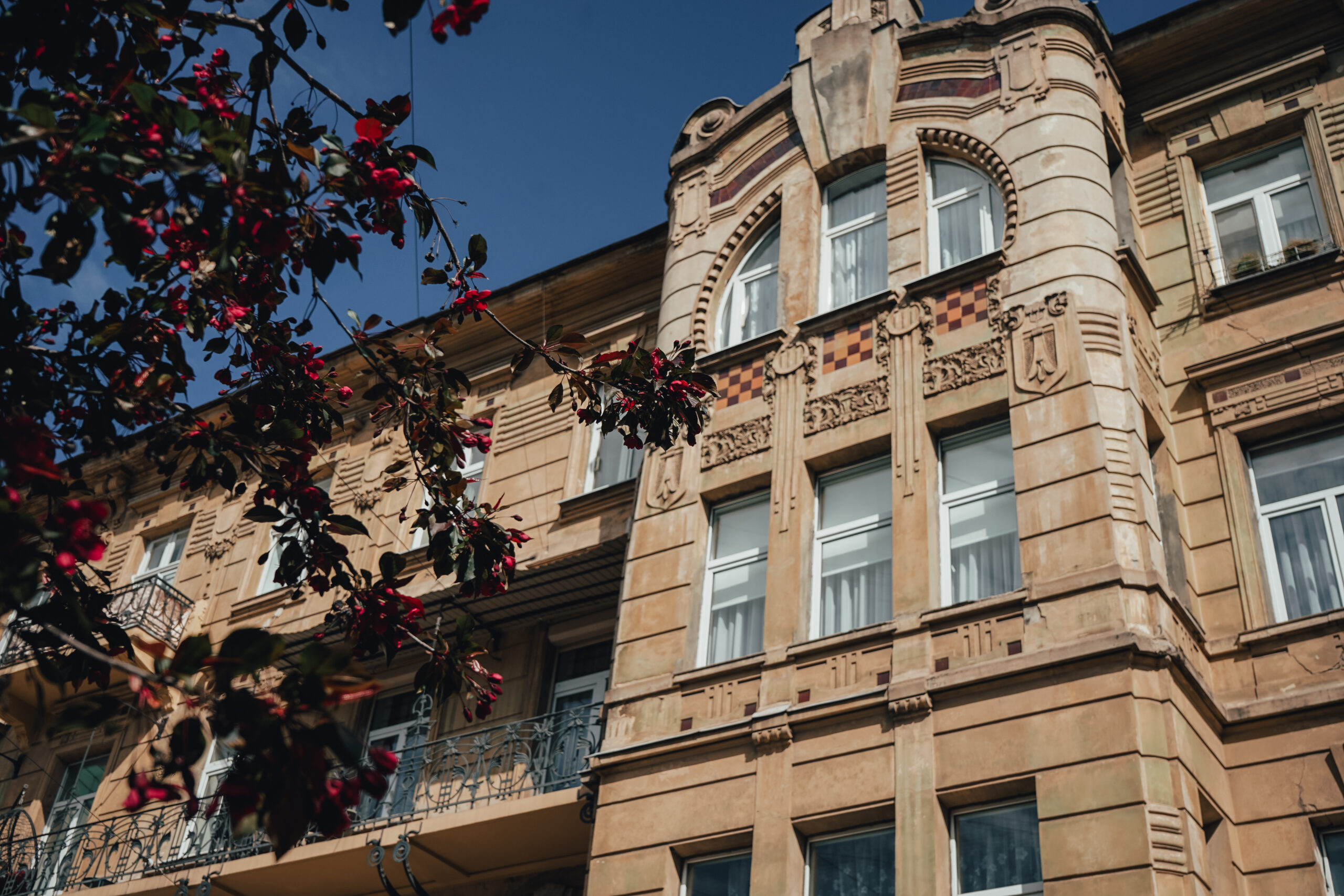
In the very heart of Lviv, at 5 Shashkevych Square, stands an unassuming three-story building in the Neoclassical style with elements of Art Nouveau. A keen observer may immediately guess that the building was intended for artistic purposes, particularly music, as the right pediment of the side facade still bears an image of a musical instrument – a kithara, symbolically framed by two lions facing away from each other. Today, this building houses the S. Lyudkevych Lviv State Music College. However, it was initially intended to be a national theater for the Ukrainian community of Galicia.
Construction began in 1913, designed by the renowned architect Ivan Levynskyi. However, World War I and financial difficulties halted the process. The lack of funds was evident even during the interior decoration of the building. The first floor soon hosted a “Cheap Kitchen” for Ukrainian youth, the proceeds of which supported the theater’s construction and later covered utility costs.
Ukrainian artist and monumental painter Modest Sosenko, a graduate of the Krakow, Munich, and Paris Academies of Fine Arts, was invited to decorate the interior with murals. The large and small halls of the Music Society were the largest secular projects he worked on. The walls of the large hall featured intricate ornamentation, while the ceiling was adorned with an image of Kobzar surrounded by muses, encircled by musical notes from Ivan Franko’s “Eternal Revolutionary.”
Sosenko’s work here was marked by profound national symbolism. The interiors were designed in a style reminiscent of traditional Poltava folk ornaments. Sosenko incorporated motifs of Poltava roses into the wall decorations and stained glass windows. These stained glass windows, created by the Krakow firm of Zhelensky based on Sosenko’s designs, have been preserved in the large hall. The motif of Ukrainian culture was present in every detail, particularly on the ceiling, where Kobzar was depicted alongside three muses dressed in traditional folk attire.
The central theme of the murals was music, reflecting the connection between folk art and Ukrainian national identity. The ceiling was adorned with the musical notes of a work by Mykola Lysenko, symbolically linking the musical heritage of eastern and western Ukraine. In the hall, there are also busts of Taras Shevchenko and Mykola Lysenko, sculpted by Hryhorii Kuznevych, while along the perimeter of the ceiling, a series of ornamental elements are considered among Sosenko’s finest works.


A mother embracing her son and daughter is regarded as a free interpretation of the image of the Virgin Mary with Intercessors. The paintings symbolize Science, Love, Education, and Folk Art. Each group is depicted in the attire of different ethnographic regions: Yavoriv, Poltava, Horodenka (where the initiator of the theater’s construction, Volodymyr Shukhevych, hailed from), and Hutsul regions. Of particular interest are the forged lights reminiscent of Hutsul-style tripodal candle holders, created by Ukrainian blacksmith Mykhailo Stefanivskyi.
The small hall on the third floor also preserves part of Sosenko’s legacy. Here, Sosenko depicted Kobzar, folk musicians, and shepherds – scenes from Ukrainian folk life that he recreated using photographs. These were among the last murals Sosenko completed before being mobilized during World War I. Unfortunately, due to the war, he was unable to finish the work, and part of the frescoes was lost or painted over, though the remaining fragments give a glimpse into the scale of his talent.
Today, the building functions as a music college, and access to the interiors is limited. However, from time to time, the college opens its doors to visitors, with exceptional tours led by scholar Roksolana Havalyuk, who skillfully immerses guests in the world of art and the history of this unique space.