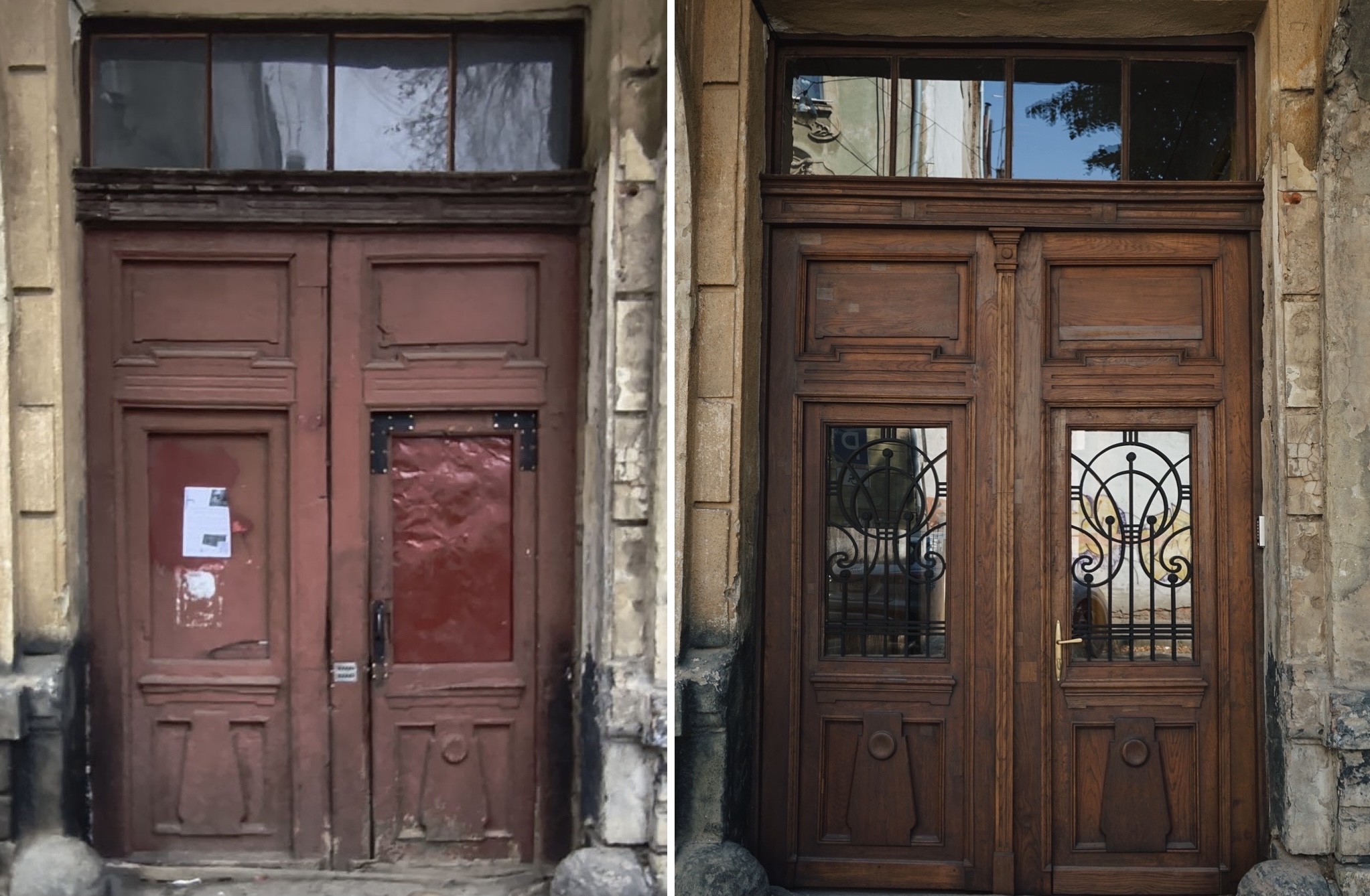
The building of the Lviv National Philharmonic named after Myroslava Skoryk, located on the street Skoryka, 7, was built for the Galician Musical Society, founded in 1838. This society is considered one of the oldest musical societies in Eastern Europe. Until the beginning of the Second World War, it played an important role in the development of musical life in Lviv and on the territory of Galicia, continuing the line of the Musical Society of St. Cecilia, founded by Franz Mozart, the son of the famous Wolfgang Amadeus Mozart.
Initially, in 1905, Vladyslav Halytsky created a project for the building in the neo-baroque style. The plans called for one part of the building to be profitable, and the other to be used as a conservatory and concert hall. However, the following year, the construction was continued according to a new project by Vladyslav Sadlovsky, executed in the Art Nouveau style. This project was so impressive that it was presented at an exhibition of Polish architects in Lviv in 1910.

The main facade is symmetrical, decorated with reliefs of musical instruments, flanked by walls, above which are superimposed Art Nouveau eaves and two metal sculptures of swans, the author of the latter is Petro Gerasimovych. The lower tier of the facade is rusticated.
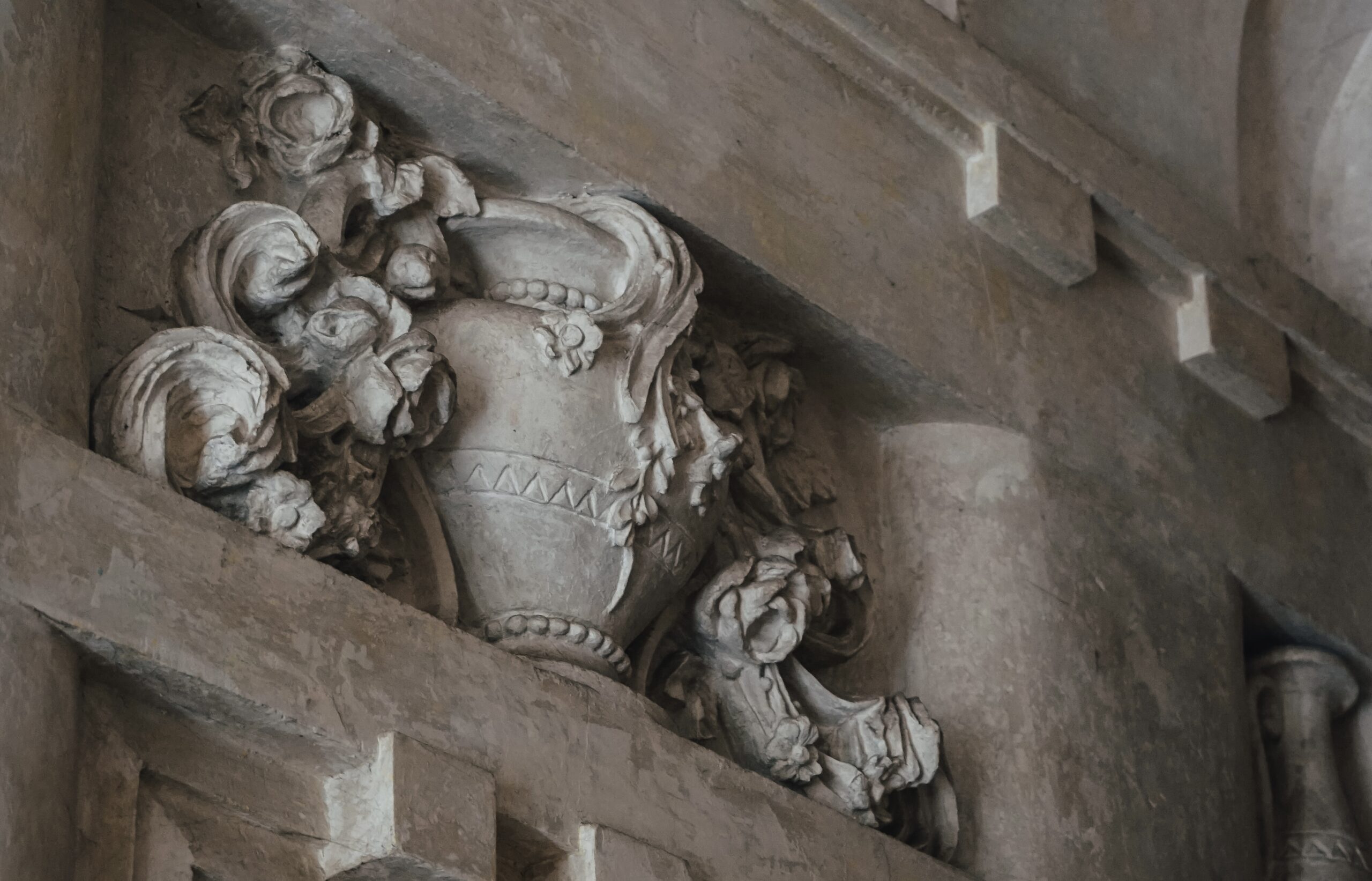
The central part at the level of the second and third floors is divided by pilasters (7 pilasters, like 7 notes), which ends with a wide protruding cornice, which separates the fourth floor from the lower ones. The capitals of the pilasters are decorated with floral ornaments. Between the windows of the second and third floors, the central part, there are “mirrors” with bas-reliefs on a musical theme. Round windows are arranged on the side walls at the level of the attic, which is decorated with stylized “strings” and ends with an Art Nouveau attic with a swan sculpture. In the middle of the central part, at the level of the second floor, there is a balcony, the concrete slab of which is wavy in plan, and the metal fence is stylized according to the musical score with notes, which is gradually transformed into a floral ornament. Balconies are also arranged along the edges of the facade at the level of the third and fourth floors. The window sills of the outer windows of the fourth floor are decorated with forged “vasonierka”. The facade ends with a modestly decorated crown cornice at the edges, and a “comb” arcade in the middle. The sheets between the windows of the fourth floor of the central part are decorated with horizontal stripes, which imitate a musical note with a treble clef. Garlands are arranged above the windows.


The main stairwell is decorated with a light lantern and stucco with a floral ornament typical of the Art Nouveau style. In the wrought-iron fence of the staircase there are symbols of musical notation and elements in the form of plants.
In 1914-1915, the hall did not work due to the war and the Russian occupation of Lviv.
In the interwar period, in addition to the Philharmonic, there was a musical instrument store, a classifieds bureau, a bank, a mutual aid society, an engraving workshop / enamel table workshop.
The building also housed a cinema called “Apollo”. The initiator of its creation was the engineer Kazimyr Kropiyovsky, who caught the trend for modern cinema spaces and opened the doors of the Apollo cinema hall on April 2, 1911. This cinema was noted for its exclusivity and the high cost of entrance tickets. The prices for tickets to this movie theater were almost commensurate with the price of tickets for theater performances, however, the audience was offered the latest movies. The opening of the cinema emphasized that the cinema was no longer considered a simple entertainment for the poor, but became a real art that attracted the attention of the urban elite.
In post-war times, it housed the concert hall of the Lysenko Conservatory, and from the 1940s, the Lviv Regional Philharmonic. The Philharmonic Hall is included in the Register of Architectural Monuments of Local Importance.

On September 29, 2020, the Lviv Regional Council assigned the name of the outstanding composer and musicologist Myroslav Skoryk to the Lviv National Philharmonic. Myroslav Mykhailovych Skoryk (July 13, 1938 – June 1, 2020) was a Hero of Ukraine, People’s Artist of Ukraine, laureate of the T.G. Shevchenko, a candidate of art history, and also held the position of co-chairman of the Union of Composers of Ukraine in 2006-2010 and was the artistic director of the Kyiv Opera from 2011 to 2016. This outstanding musician was also the great-nephew of the famous singer Solomia Krushelnytska. Since 2009, Myroslav Skoryk has been the artistic director of the Youth Academic Symphony Orchestra “INSO-Lviv”.
Sources and literature:
- Architecture of Lviv: Time and styles. XIII – XXI centuries. Compiler and scientific editor Yu.O. Biryulov. – Lviv: Center of Europe, 2008.
- VUL. CHAIKOVSKOHO, 7 – LVIV PHILARMONY BUILDING
- VUL. TSCHAIKOVSKOHO, 7 – FORMER APOLLO CINEMA
- “Apollo”: a cinema for the elite, or a movie screening at the price of a performance, source: Photos of old Lviv