In the buildings of the Art Nouveau period, both in the interior and in the exterior, various materials are harmoniously combined: metal and stone, wood and glass, wallpapers of various textures and paintings, stained glass windows. Today we will talk about metal and its use in Art Nouveau style.

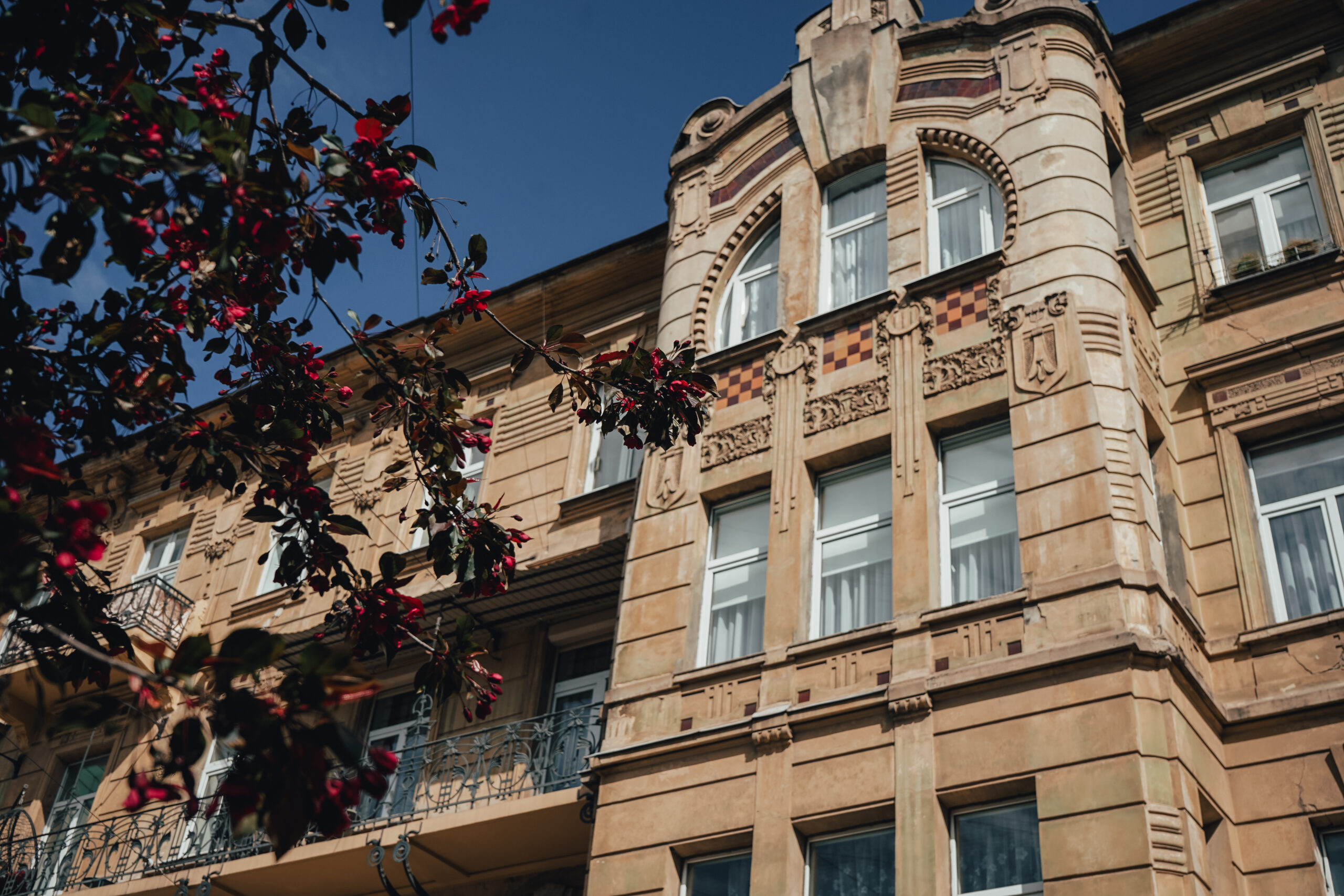
Artistic metal was used to create ornaments, decorative elements, in particular, on the facade, in particular, to create lattices, planters, balcony railings, stair railings and other details. These metal elements gave Art Nouveau buildings a characteristic light and harmonious look.
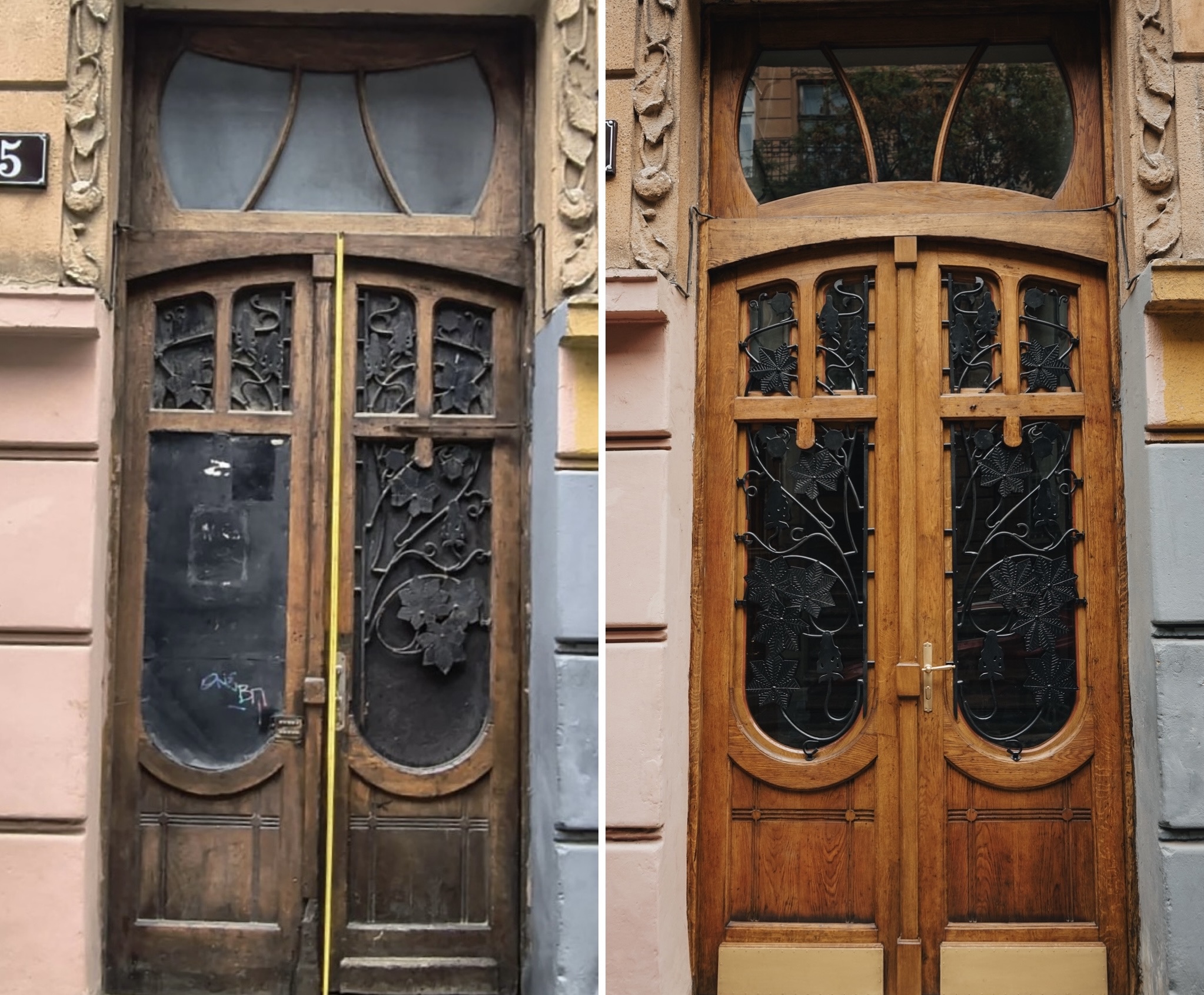
One of the most vivid examples that can reflect the artistic qualities of Lviv plastic during the Art Nouveau period are the entrance doors of residential buildings, which are often called “gates”. The metalwork of Lviv impresses with a variety of symbolic compositions – plant motifs, naturalistic and stylized tree branches, sunflowers, and lilies. The search for decorative form expanded due to complex combinations of lines, riveted joints and the use of standardized elements of pressed and perforated sheet metal. Meanders, three- and six-petalled rosettes, motifs of concentric rings, etc. fascinate with a variety of compositional and decorative solutions. In secessionist forms, the special nature of the line, its purity, ability to transform into a plane, a spot attracts attention. An S-shaped line is preferred.
The plants were creatively reproduced with sinuous, unbounded and wavy lines in the metal and looked spectacular on the gates, windows and roofs of the buildings. winding, unlimited and wavy lines.
At the end of the 19th and the beginning of the 20th centuries, Lviv was marked by significant development of blacksmithing art. There were almost two dozen firms and workshops specializing in architectural blacksmithing.

Lattices of the I. Levinsky company are characterized by a crystalline structure and geometry, close to folk ornamentation.
The orders of Ukrainian architects (in particular, Lev Levinskyi) for the execution of forged lattices and acquired crosses were carried out by the workshop of M. Stefanivskyi and the locksmith workshop of I. Hlynchak in Lviv.
Lviv architects of the late 19th and early 20th centuries took an active part in the creation of artistic metal products. Oleksandr Lushpinsky, together with Lev Levinsky, Yevhen Nagirny, Alfred Zaharievich and other architects, using the ornamental and form-forming motifs of Ukrainian folk art, created original stylized compositions for metal products, which defined a new direction in artistic metal of the beginning of the 20th century, associated with Ukrainian architectural style. Such works by Oleksandr Lushpinskyi were designed for buildings at 20 Ruska Street (1903-1906) and 11a General Chuprinka Street (1906-1907) and others.

One of the notable examples of forged metal embodied in the spirit of Ukrainian folk art at the beginning of the 20th century was the joint project of I. Levinskyi and O. Lushpinskyi – the People’s House bursa building at 14 Lysenko Street in Lviv (1906). Metal parts for interior and exterior decoration were made in the workshop of M. Stefanivskyi in 1907. The artistic ensemble included metal decoration of doors, door handles, stairwells, several options for window grills, the outer grid of the fence, balcony grills and brackets, entrance gates, which form a single integral composition both among themselves and in the context of the entire exterior of the building. Elements of folk stylistics are partially traced here.

An important decorative element of the decoration of the building in the Secession era were metal architectural finishes – vanes, rapids, spiers, grilles – made mainly in the forging technique. Similar finishes crown the houses on the street. General Chuprinka, Kulparkivska, Lysenko, Pryvokzalnaya, Dombrovsky, Dudayev, Shevchenko avenues. Weather vanes in the form of roosters (as on the metal porch of the house of the beginning of the 20th century at 4 Dombrovskyi St.), dragons, and ducks were popular. Building tower on the street General Chuprinka, 22 is crowned by a low wrought-iron lattice with a floral ornament. The vane itself is decorated with S-shaped lines and spiral rods. The image of the duck is made using the slotted technique, the weather vane is the dominant feature of the decorative decoration of the house. There are weather vanes in the form of an arrow, a spear. Popular metal architectural finishes were profiled spheres, as well as lattices. In the latter, the influence of European modernism is observed.
The masters managed to creatively combine the forms of Western European modernism with the transformed motifs of folk art. The main idea of modernism was the synthesis of arts to create a complete, harmonious image with the environment.
Photo: Heritage Bureau.
According to the materials of the article by Ivan Franko, honored artist of the arts of Ukraine, private professor, head of the artistic metal department of the National Academy of Sciences “Forged metal in Lviv at the beginning of the 20th century. Modern”, published in the Bulletin of the Lviv National Academy of Arts. Vol. 38. 2018.